
Teeth Whitening in NYC: Professional vs. At-Home (A Dentist’s Honest Take)
Let’s Be Honest About Whitening
Teeth whitening is one of the most searched cosmetic dental topics in New York City, and also one of the most misunderstood. Walk through any pharmacy in Manhattan, and you’ll find an entire aisle of strips, pens, trays, and LED kits all promising a brighter smile. Meanwhile, professional whitening treatments at a cosmetic dental office deliver noticeably different results.
So what’s actually going on? As a cosmetic dentist on the Upper East Side, I want to give you a genuinely honest breakdown, not a sales pitch for our in-office treatment, but a clear-eyed look at what works, what doesn’t, and how to choose the right option for your specific situation.
“The question isn’t always which whitening method is ‘best.’ The better question is: which is right for your teeth, your timeline, and your goals?”
First: Understand What Whitening Actually Does
All teeth whitening, professional or over-the-counter, works through a chemical process called oxidation. Peroxide-based agents (hydrogen peroxide or carbamide peroxide) penetrate the enamel and break apart the molecular bonds of stain compounds embedded in your teeth.
The key variable is concentration. Professional treatments use significantly higher concentrations of peroxide than anything available over the counter. That’s not arbitrary; it’s regulated, and for good reason. Higher concentrations require clinical supervision to manage sensitivity and protect the surrounding gum tissue.
It’s also worth knowing what whitening cannot do: it does not work on crowns, veneers, or bonding. It also has limited effect on intrinsic staining caused by tetracycline antibiotics or fluorosis. If either of these applies to you, porcelain veneers are typically a more effective solution, something we’d discuss during a cosmetic dentistry consultation at our Manhattan practice.
The Three Whitening Options: A Real Comparison
Option 1: Professional In-Office Whitening
BEST FOR: FAST, DRAMATIC RESULTS IN A SINGLE VISIT
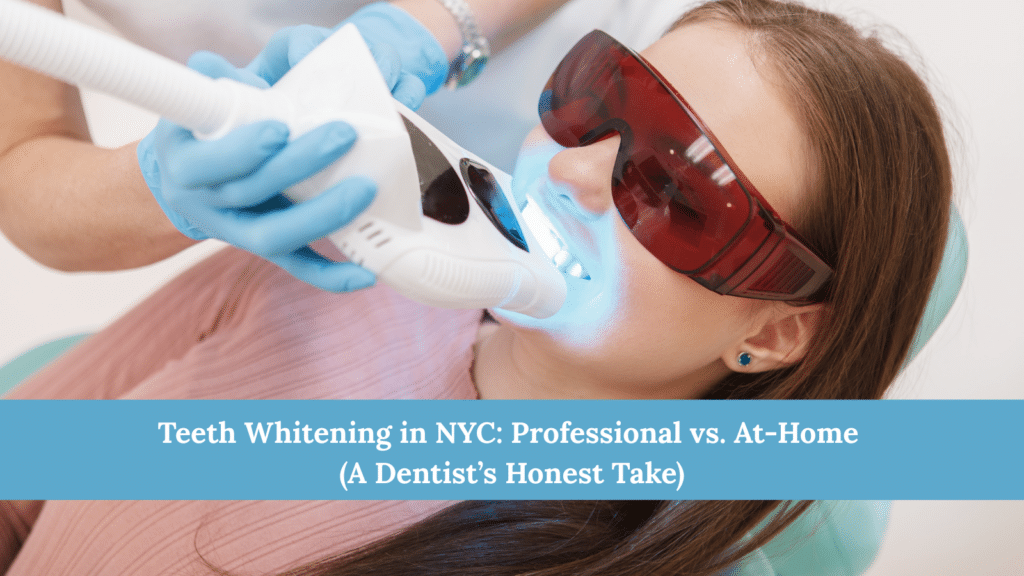
In-office whitening, performed at our Upper East Side dental practice, uses a high-concentration peroxide gel (typically 35–40%) applied directly to your teeth. At the same time, your gums are carefully protected with a barrier. The treatment takes about 60–90 minutes and can lighten teeth by six to ten shades in a single appointment.
We also offer light or laser activation with certain systems to accelerate the process. Patients who have a wedding, event, or simply want immediate results tend to prefer this option.
One thing we address proactively: sensitivity. Some patients experience temporary sensitivity after in-office whitening. We use desensitizing agents before and after treatment, and we’ll discuss your sensitivity history beforehand to determine whether any adjustments are needed.
Advantages of In-Office Whitening
- Fastest results, dramatic change in one visit
- Highest concentration available
- Gums and soft tissue protected throughout
- Supervised by an experienced cosmetic dentist
- Customized to your tooth color goals
Considerations
- Higher cost than at-home options
- Some patients experience temporary sensitivity
- Results still require maintenance over time
Option 2: Dentist-Supervised Take-Home Whitening
BEST FOR: GRADUAL WHITENING WITH PROFESSIONAL-GRADE RESULTS
This is an option that many patients don’t realize exists, and it’s often the one I recommend most frequently. Dentist-supervised take-home whitening uses custom-fitted trays made from impressions of your teeth, combined with a professional-strength carbamide peroxide gel (typically 10–22%).
You wear the trays for a prescribed amount of time each day, usually 30–60 minutes or overnight, for two to four weeks. The results are excellent, often comparable to in-office treatment, but the whitening happens gradually and gently. This approach is particularly well-suited to patients with sensitivity concerns.
The custom trays are a meaningful advantage over any OTC option: they ensure even, consistent contact between the gel and your teeth, minimize waste, and protect your gums from gel exposure.
Advantages of Take-Home Whitening
- Professional-strength results at a lower cost than in-office
- Gentler on sensitive teeth, more control over pace
- Custom trays ensure even, accurate application
- Trays can be reused for maintenance touch-ups
- Flexible, whiten on your own schedule
Considerations
- Results take 2–4 weeks rather than a single visit
- Requires commitment to wearing trays consistently
- Gel must be handled and stored correctly
Option 3: Over-the-Counter Whitening Products
BEST FOR: MILD STAINING, MAINTENANCE, CONVENIENCE
Let’s be fair: OTC whitening products do work, to a degree. Whitening strips from reputable brands use 3–10% hydrogen peroxide and can lighten teeth by one to three shades over four to eight weeks of consistent use. That’s a real improvement for people with mild surface staining.
The limitations are meaningful, though. Because the strips are not custom-fitted, gel exposure to your gums is inconsistent and often uncomfortable. Application is uneven, particularly around the edges and between teeth. And the lower concentration means you need significantly more time for a more modest result.
OTC products are also entirely unsupervised. If you have existing dental work, sensitivity, receding gums, or any other condition that affects how whitening interacts with your teeth, you won’t know until you experience a problem.
Advantages of OTC Whitening
- Most affordable upfront
- Widely available, convenient
- Good for maintaining results after professional whitening
Considerations
- Weakest concentration, most modest results
- Not custom-fitted; uneven application
- Can cause sensitivity, especially in strips
- No dental supervision
Side-by-Side Comparison
Here’s a complete breakdown to help you choose:
| Factor | Professional In-Office | Dentist-Supervised Take-Home | OTC Strips / Kits |
| Whitening agent | 35–40% hydrogen peroxide | 10–22% carbamide peroxide | 3–10% hydrogen peroxide |
| Results timeline | 1–2 appointments | 2–4 weeks | 4–8+ weeks |
| Shades lighter (avg) | 6–10 shades | 4–8 shades | 1–3 shades |
| Custom trays | Yes | Yes | No |
| Supervised by dentist | Yes | Yes | No |
| Good for sensitivity | With prep; ask your dentist | Gentler protocol available | Variable — often causes sensitivity |
| Cost | Higher upfront | Moderate | Lower |
| Longevity | 1–3 years with care | 1–2 years with care | Months |
| Best for | Fast, dramatic results | Flexible, gradual whitening | Mild, convenience-driven |
Who Is a Good Candidate for Teeth Whitening?
Most patients with healthy teeth and gums are good candidates for whitening. Before we begin any whitening treatment at our Manhattan dental practice, we do a brief assessment to confirm:
- No untreated cavities or active gum disease
- Realistic expectations about the degree of change possible
- Understanding that existing restorations won’t change color
- No conditions (like severe sensitivity) that would require modification
If whitening isn’t the right fit, because of the nature of your staining, existing crowns, or other factors, we’ll tell you, and we’ll discuss alternatives like porcelain veneers that can achieve a brighter, more uniform result.
How Long Does Whitening Last?
Professional whitening results typically last one to three years, depending on your diet, oral hygiene habits, and whether you smoke. Foods and drinks like coffee, red wine, tea, and berries are the primary culprits in re-staining teeth.
Our recommendation: After in-office or take-home whitening, use a whitening toothpaste for daily maintenance and keep your custom trays. A brief touch-up with the take-home gel every six to twelve months keeps your results looking fresh with minimal effort.
A Note on Whitening Toothpastes and Trends
Two questions we hear frequently:
Do whitening toothpastes work? Modestly. They contain mild abrasives and sometimes low concentrations of peroxide. They’re useful for removing surface stains and maintaining whitening results, but they won’t produce dramatic changes on their own.
What about charcoal toothpaste? We’d steer clear. Activated charcoal is highly abrasive and can damage enamel over time. There’s no credible evidence that it whitens teeth more effectively than conventional options — and there’s real potential for harm.
What about LED whitening devices? The LED component in most consumer kits isn’t doing much of the whitening work — it’s the peroxide gel doing the job. In-office systems that use light activation are a different story, as they’re calibrated to specific wavelengths with clinical-grade gels.
Ready to Brighten Your Smile in Manhattan?
Whether you’re considering an in-office treatment for a fast transformation or a take-home kit for a gradual, gentle result, we’d love to help you find the right approach. At our cosmetic dental practice on the Upper East Side, we take whitening seriously, because done right, it’s one of the most impactful, affordable improvements you can make to your smile.
Reach out to schedule a consultation or ask us about whitening options at your next visit.