

Invisalign vs. Traditional Braces: Which Is Better for Adults in Manhattan?
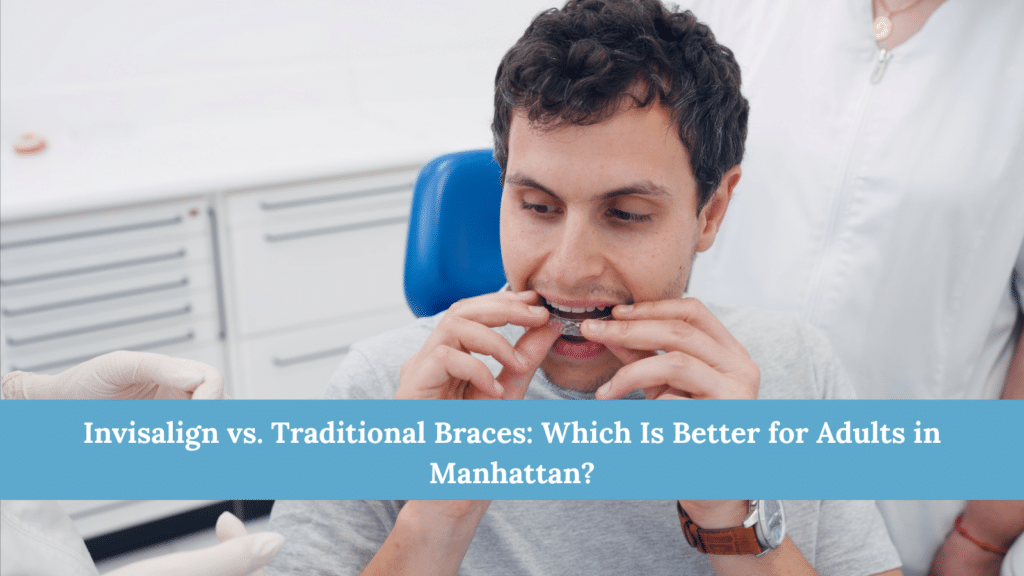
If you are an adult considering orthodontic treatment in New York City, you are likely weighing two options: Invisalign clear aligners or traditional metal braces. Both can straighten teeth effectively. But for most adults, the decision comes down to lifestyle, treatment complexity, and what the experience will actually be like day to day.
This guide walks through the key differences between Invisalign and braces for adult patients, what each option costs in Manhattan, and how to think about which is right for your specific situation.
Invisalign vs. Braces: Side-by-Side Comparison
| Invisalign | Traditional Braces | |
|---|---|---|
| Visibility | Nearly invisible | Visible metal or ceramic brackets |
| Removability | Removable for eating and cleaning | Fixed for duration of treatment |
| Treatment Duration | 6 to 18 months (most adult cases) | 18 to 36 months |
| Comfort | Smooth plastic, no brackets or wires | Brackets and wires can irritate soft tissue |
| Maintenance | Remove to brush and floss normally | Requires special tools; more time-intensive |
| Diet Restrictions | None | Avoid hard, sticky, crunchy foods |
| Office Visits | Every 6 to 8 weeks | Every 4 to 6 weeks |
| Cost (Manhattan) | $5,000 to $8,500 | $3,000 to $7,000 |
| Best For | Mild to moderate misalignment; image-conscious adults | Complex cases; patients who prefer a fixed appliance |
Costs reflect current Manhattan orthodontic market rates and vary based on case complexity and provider.
Invisalign for Adults: What You Should Know
Invisalign uses a series of custom-made clear plastic aligners, each worn for approximately one to two weeks, to gradually shift teeth into alignment. Each set moves your teeth a small, precise amount according to a digital treatment plan developed at the start of your case.
The Adult Appeal
Invisalign became the dominant choice for adult orthodontic patients largely because of one thing: no one can tell you are wearing them. For professionals, public-facing roles, or anyone who simply does not want to navigate social and professional life with visible hardware on their teeth, clear aligners are a meaningful quality-of-life advantage.
The removability is equally significant. Invisalign patients eat whatever they want, brush and floss with no special technique, and can remove their aligners for important meetings, photographs, or occasions. Most adults adapt to wearing them the required 20 to 22 hours per day within the first week.
Treatment Timeline
Most adult Invisalign cases at JCL Dental are completed in 6 to 18 months, depending on the degree of correction needed. Mild cases involving minor crowding or spacing can resolve faster. More significant alignment corrections take longer. Your treatment plan will include a projected timeline at the outset based on your specific tooth movements.
Limitations
Invisalign is highly effective for a wide range of cases, but it is not appropriate for every orthodontic problem. Severe crowding, significant bite issues (such as a pronounced overbite or underbite), and certain rotations are better addressed with fixed appliances. Dr. Lattinelli will evaluate your case at your consultation and let you know candidly whether Invisalign is a realistic path to your goal.
Compliance also matters. Because aligners are removable, they require self-discipline. Patients who remove them too frequently or forget to wear them will not achieve the planned result on schedule. Invisalign rewards consistent wear and is not a good fit for anyone unlikely to maintain the discipline the treatment requires.
Traditional Braces for Adults: When They Make Sense
Traditional braces use metal brackets bonded to each tooth and connected by archwires that apply continuous pressure to guide teeth into position. They are the most established orthodontic technology and remain the most effective option for complex tooth movement.
When Braces Are the Better Choice
For adult patients with significant crowding, bite corrections, or complex rotations, braces often deliver more precise results than aligners. The continuous, controlled force of a fixed appliance gives orthodontists a level of mechanical control that is difficult to replicate with removable trays.
Some adults also prefer the fixed nature of braces. Compliance is not a variable; the appliance is always working. Patients who know they would struggle to maintain aligner wear time often do better with a treatment that removes the decision entirely.
Ceramic Braces
For adults who need the mechanical advantages of a fixed appliance but want a less conspicuous look, ceramic braces are worth considering. The brackets are tooth-colored rather than metal, making them significantly less visible from a conversational distance. They function the same way as traditional metal braces and are appropriate for the same range of cases.
The Downsides for Adults
The primary drawbacks of traditional braces for adult patients are visibility and daily maintenance. Food restrictions are real and affect diet in meaningful ways. Oral hygiene is more effortful, requiring interdental brushes and floss threaders. And for adults in professional or social settings where appearance matters, brackets and wires are simply more conspicuous than most patients prefer.
Cost of Invisalign vs. Braces in Manhattan
Orthodontic treatment in Manhattan reflects the same market dynamics as other dental services in the city: premium labs, experienced providers, and high overhead all factor into fees. As a general guide:
- Invisalign: $5,000 to $8,500, depending on case complexity and number of refinements needed
- Traditional metal braces: $3,000 to $7,000
- Ceramic braces: $4,000 to $8,000
The cost difference between Invisalign and braces has narrowed significantly over the past decade. For straightforward adult cases, the fees are often comparable. More complex cases requiring significant tooth movement may favor braces on cost, since Invisalign for complex cases often involves additional refinement aligners that extend the total.
Does Insurance Cover Orthodontics?
Many dental insurance plans include an orthodontic benefit, typically a lifetime maximum between $1,000 and $2,000. This benefit applies to both Invisalign and traditional braces when the treatment is deemed clinically necessary. Plans vary considerably, so confirming your specific benefit before treatment begins is worthwhile.
At JCL Dental, our team will review your coverage with you and identify whatever orthodontic benefit applies to your plan.
Financing Options
As with other elective dental procedures, most patients use financing to spread the cost of orthodontic treatment. CareCredit and Lending Club Patient Solutions are widely accepted and offer promotional interest periods for qualified applicants. Ask about in-house payment arrangements at your consultation as well.
Am I a Good Candidate for Invisalign?
Most adults with mild to moderate misalignment are good Invisalign candidates. The technology has advanced considerably since its early years, and the range of cases treatable with aligners is now much broader than it once was. Common presentations that respond well to Invisalign include:
- Crowded teeth (mild to moderate)
- Gaps between teeth
- Mild overbite or underbite
- Crossbite
- Teeth that have shifted after prior orthodontic treatment
Cases that are more likely to require braces include severe crowding, significant skeletal discrepancies, or tooth movements that require precise torque control. The only way to know definitively is an in-person evaluation. X-rays and a clinical exam allow Dr. Lattinelli to assess your bone structure, root positions, and bite in full; none of which can be assessed accurately from photos.
What to Expect During Invisalign Treatment at JCL Dental
Invisalign treatment at JCL Dental begins with a digital scan of your teeth, no physical impressions. The scan data is used to build a precise 3D model of your current alignment and to generate the full sequence of aligner trays that will move your teeth to the final position.
Before treatment begins, you will be able to see a digital preview of the expected outcome. This is a useful reference, not a guarantee (tooth movement is a biological process and individual results vary), but it gives you a realistic sense of what the treatment is designed to achieve.
You will pick up your first sets of aligners and return for check-ins every six to eight weeks. At these visits, Dr. Lattinelli will confirm that your teeth are tracking to the plan and make any needed adjustments. Most patients find the appointments quick and straightforward.
At the end of active treatment, retainers are prescribed to hold the result. This applies equally to patients who have had braces. Retention is not optional; teeth have a natural tendency to drift, and without retainers, some relapse is likely over time.
Frequently Asked Questions
Can adults get Invisalign at any age?
Yes. There is no upper age limit for Invisalign or orthodontic treatment generally. Adult patients in their 40s, 50s, and beyond routinely complete successful orthodontic treatment. The primary clinical requirement is that your gums and supporting bone are healthy enough to support tooth movement. A routine dental exam will confirm whether you are ready to start.
How long do I have to wear my aligners each day?
Invisalign requires 20 to 22 hours of wear per day. Most patients wear them continuously except when eating, drinking anything other than water, and brushing. Patients who maintain this discipline consistently tend to finish on or ahead of their projected timeline.
Will Invisalign affect my speech?
Some patients notice a slight lisp during the first few days of wearing a new set of aligners. This is temporary and typically resolves within a few days as the mouth adjusts. Most patients find the adjustment period minimal after the first one or two sets.
What happens if I lose an aligner?
Contact your provider right away. Depending on where you are in the sequence, you will either move to the next set early or have a replacement tray ordered. Losing an aligner is not uncommon and is not a treatment emergency, but it should be addressed promptly to avoid disrupting your progress.
How do Invisalign results compare to braces?
For cases that fall within Invisalign's treatment scope, outcomes are comparable to braces. The key variable is case selection: Invisalign performs best when used for cases it is designed to treat. For complex cases pushed beyond those boundaries, results may be less predictable. A thorough consultation and honest case assessment from a qualified provider is the best protection against that outcome.
Ready to Find Out Which Option Is Right for You?
The best way to know whether Invisalign or braces is the right choice is a consultation with a provider who will evaluate your case honestly, not just recommend whatever is easier to sell.
Dr. Lattinelli has been helping adults on the Upper East Side achieve straighter, healthier smiles for decades. To schedule a consultation, call 212-752-7188.
For a full overview of cosmetic and restorative services at JCL Dental, visit our Complete Guide to Cosmetic Dentistry on the Upper East Side.