Dental Implants in Manhattan: Everything You Need to Know

Missing teeth affect more than your smile. They can change how you chew, how your other teeth shift over time, and how confident you feel in everyday conversations. Dental implants have become the most reliable long term solution for replacing missing teeth, offering a natural look and feel that bridges and dentures often cannot match. If you are researching dental implants in Manhattan, you likely have questions about cost, what the procedure actually involves, and how long recovery takes. This guide walks through everything you need to know before your first consultation, so you can make an informed decision with confidence.

What Are Dental Implants?

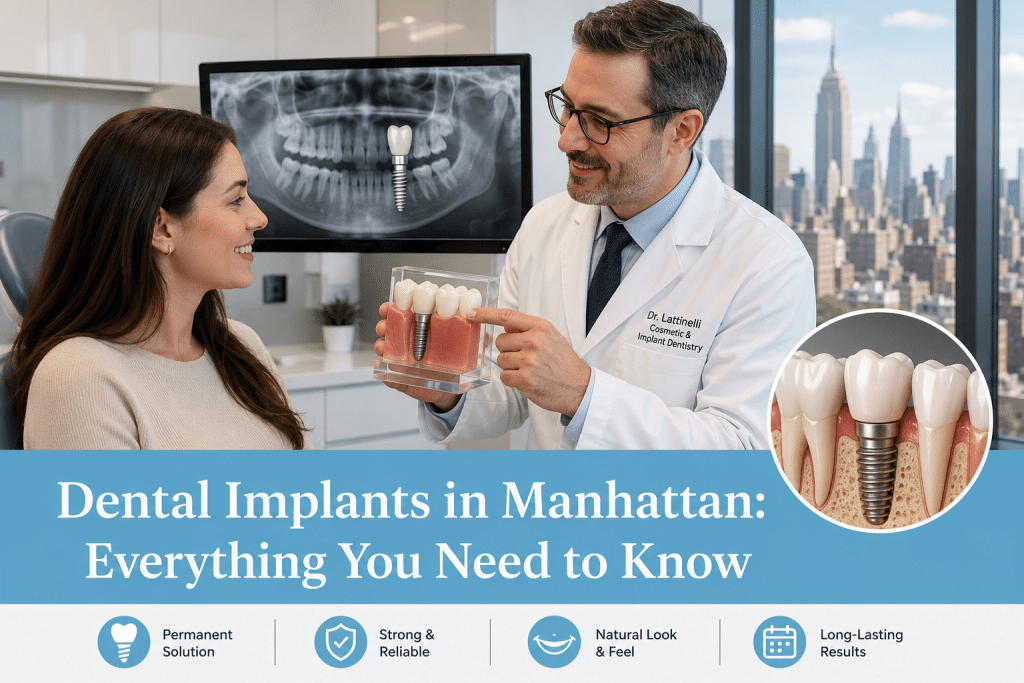
A dental implant is a small titanium post that is surgically placed into the jawbone, where it functions as an artificial tooth root. Once the bone heals around the implant, a custom crown is attached on top, creating a replacement tooth that looks, feels, and functions like a natural one. Unlike removable dentures, implants are permanent and do not rely on surrounding teeth for support, which also helps preserve jawbone density that would otherwise be lost over time.

Implants vs. Bridges vs. Dentures

Bridges require grinding down healthy adjacent teeth to anchor a replacement, which can weaken those teeth over time. Dentures are removable and often shift or slip while eating or speaking. Implants avoid both drawbacks. They stand on their own, do not affect neighboring teeth, and stay firmly in place, making them the closest option to a natural tooth in both function and appearance.

How Much Do Dental Implants Cost in Manhattan?

Dental implant costs vary widely depending on the number of teeth being replaced, the condition of your jawbone, and whether additional procedures like bone grafting are needed. In Manhattan, a single implant, including the post, abutment, and crown, typically ranges from about 3,500 to 6,000 dollars. Full mouth implant solutions, such as implant supported dentures, can range from 20,000 to 45,000 dollars or more depending on complexity. Several factors influence the final price, including the type of implant material used, whether a specialist performs the placement, and any preparatory work such as bone grafting or tooth extraction. It is worth noting that while implants often carry a higher upfront cost than bridges or dentures, they typically last much longer and require fewer replacements over a lifetime, which can make them more cost effective in the long run. During your consultation, Dr. Lattinelli's team will provide a clear, itemized estimate before any treatment begins, so there are no surprises along the way.

The Dental Implant Procedure Step by Step

While every case is unique, most dental implant treatments follow a similar sequence from initial evaluation to final restoration.

Step 1: Consultation and Imaging

Your dentist will take digital X-rays or a 3D scan to evaluate your jawbone density and plan the exact placement of the implant.

Step 2: Implant Placement

The titanium post is surgically placed into the jawbone under local anesthesia. Most patients report only mild discomfort, similar to a tooth extraction.

Step 3: Healing and Osseointegration

Over the following months, the bone fuses to the implant in a process called osseointegration, creating a stable foundation for the new tooth.

Step 4: Crown Placement

Once healing is complete, a custom crown is attached to the implant, matched to the color and shape of your natural teeth for a seamless result.

Recovery Timeline: What to Expect Week by Week

Recovery from dental implants happens in stages, and knowing what is normal at each point can ease a lot of unnecessary worry.

Week 1

Mild swelling and soreness are common and typically manageable with over the counter pain relief. Most patients return to work within a day or two.

Weeks 2 to 6

Initial soft tissue healing is complete, and any stitches have dissolved or been removed. The jawbone continues to heal around the implant beneath the surface.

Months 3 to 6

Osseointegration is typically complete during this window, at which point the implant is stable enough to support a permanent crown. Most patients experience little to no discomfort by this stage and can eat, speak, and brush normally without noticing a difference from their natural teeth.

Are You a Candidate for Dental Implants?

Most healthy adults with sufficient jawbone density are good candidates for dental implants. Factors that can affect candidacy include uncontrolled diabetes, active gum disease, smoking, and significant bone loss, though many of these can be managed or treated before implant placement. Age alone is rarely a barrier. Many patients in their seventies and eighties successfully receive implants, as long as they are in reasonably good overall health. The only way to know for certain is a thorough evaluation, including imaging, to assess your specific situation and jawbone structure.

Financing and Insurance Options

Dental insurance often covers only a portion of implant costs, since some plans classify implants as a cosmetic procedure rather than a medical necessity. To help make treatment more accessible, many Manhattan practices, including Dr. Lattinelli's office, offer financing plans through third party providers, allowing patients to spread payments out over several months or longer with manageable monthly amounts.

Why Choose Dr. Lattinelli for Implants in Manhattan

Dr. Lattinelli's practice combines advanced 3D imaging with years of hands on implant experience, allowing for precise placement and predictable results. Patients receive a clear, itemized treatment plan before starting, transparent guidance through every stage of healing, and access to a full range of services under one roof, so a missing tooth never turns into a complicated, multi office ordeal. Because implant placement and restoration happen within the same practice, there is no need to coordinate between separate specialists or repeat your history at multiple offices, which keeps treatment simpler and more consistent from start to finish.

Frequently Asked Questions

Do dental implants hurt?

Most patients report less discomfort than expected. The procedure is performed under local anesthesia, and any post procedure soreness is typically managed with over the counter pain medication.

How long do dental implants last?

With proper care, dental implants can last 20 years or longer, and many patients keep them for life.

Can I get a dental implant if I have bone loss?

In many cases, yes. A bone graft can rebuild sufficient density before or during implant placement, and your dentist can determine if this is necessary during your consultation.

Will my dental implant look natural?

Yes. The crown attached to your implant is custom shaded and shaped to match your surrounding teeth, so the final result blends in seamlessly with the rest of your smile.

Schedule Your Implant Consultation With Dr. Lattinelli

If you are considering dental implants in Manhattan, the best next step is a consultation to discuss your specific needs, timeline, and cost. Dr. Lattinelli's team is here to walk you through every option, answer your questions honestly, and help you decide if implants are the right fit.

Dr. Lattinelli

121 East 60th St., 10th Floor

New York, NY 10022

Phone: 212-752-7188

How to Choose the Best Dentist in Manhattan: 7 Questions to Ask Before Your First Visit

Manhattan has no shortage of dental practices. You can find one on nearly every block, from the Upper West Side to the Financial District. But having options isn't the same as having a good choice. Whether you just moved to the city, switched insurance plans, or simply haven't loved your last few cleanings, finding the best dentist in Manhattan means looking past flashy websites and convenient locations to what actually matters: training, technology, patient experience, and long-term care. Before you book your first appointment anywhere, ask these seven questions. They will help you separate a dental office that's merely nearby from one that's genuinely right for you and your family.

Question 1: What Are Their Credentials and Experience?

Best Dentist in NYC

Start with the basics. A qualified dentist should be licensed to practice in New York State, and any specialized services, such as implants, Invisalign, or sedation dentistry, should be backed by additional training or certification, not just a weekend course. Look for a dentist who lists their education, years in practice, and any professional memberships, such as the American Dental Association or the New York State Dental Association, directly on their website. Experience matters most for complex procedures. If you are considering dental implants or a full smile makeover, ask how many similar cases the dentist has completed and whether they perform the procedure in house or refer it out. A dentist who is upfront about their background, and happy to answer questions about it, is usually a good sign of transparency in every other part of your care.

Question 2: Do They Use Modern Technology?

Dentistry has changed dramatically over the past decade, and the best practices keep pace. Digital X-rays expose patients to significantly less radiation than traditional film and let your dentist review images instantly. Intraoral scanners have replaced messy, uncomfortable impression putty for crowns, aligners, and implants. Same-day crown machines, such as CEREC, can save you a second visit entirely. When you are comparing dentists in Manhattan, ask what equipment they use for diagnostics and treatment planning. It is not about chasing every new gadget. It is about whether a practice invests in tools that make treatment faster, more accurate, and more comfortable for you.

Question 3: What Do Real Patient Reviews Say?

Star ratings only tell part of the story. Read through recent reviews on Google, Yelp, and Healthgrades and look for patterns rather than one off complaints. Do multiple patients mention long wait times, surprise charges, or rushed appointments? Or do they consistently praise a particular hygienist, a thorough explanation of treatment options, or a comfortable, low pressure environment? Pay close attention to how a practice responds to negative reviews. A thoughtful, professional response says a lot about how they will handle concerns if something does not go as planned during your own care. A dentist with hundreds of consistent, detailed positive reviews over several years is generally a safer bet than one with a handful of generic five star ratings.

Question 4: Do They Offer Emergency or Same-Day Care?

Dental emergencies rarely happen on a convenient schedule. A cracked tooth on a Friday night or sudden, severe pain should not mean waiting until Monday, or heading to an urgent care center that is not equipped for dental issues. Ask any practice you are considering whether they offer same day emergency appointments and what their after hours protocol looks like. The best dentists in Manhattan build flexibility into their schedules specifically for these situations, so existing patients are not left scrambling when something goes wrong.

Question 5: What Is Their Approach to Comfort and Anxiety?

Dental anxiety is extremely common, and it is a legitimate reason to choose one practice over another. Ask how the team supports nervous patients. Options might include nitrous oxide, noise canceling headphones, weighted blankets, or simply a dentist who takes time to explain each step before doing it. A practice that treats comfort as a priority, not an afterthought, tends to deliver a better experience across the board, from routine cleanings to more involved procedures.

Question 6: Do They Offer a Full Range of Services?

Bouncing between multiple specialists for different needs is inconvenient and can fragment your care. Ideally, your dentist can handle everything from routine cleanings and fillings to more advanced treatments like dental implants and cosmetic dentistry, all under one roof. This matters for two reasons: continuity of care, since one provider has your full history and can plan treatment holistically, and convenience, since you are not re-explaining your dental history to a new office every time a new need comes up.

General Dentistry

Routine exams, cleanings, fillings, and preventive care form the foundation of a healthy smile and should always be available close to home.

Dental Implants

For missing or severely damaged teeth, implants offer a permanent, natural looking solution that a full service dentist can plan and place without an outside referral.

Cosmetic Dentistry

Veneers, whitening, and Invisalign let patients improve the look of their smile alongside their regular dental care, all with one trusted provider.

Question 7: Is the Office Conveniently Located and Accessible?

In a city where commute times and subway lines factor into nearly every decision, location matters more than people admit. A dentist who is a quick walk from your office or apartment is one you will actually get to for regular cleanings, not one you will keep postponing because it is a 40 minute trip. Check for accessibility features too, including step free entry, elevator access, and evening or weekend hours that fit a busy Manhattan schedule.

Why Manhattan Patients Choose Dr. Lattinelli

At Dr. Lattinelli's practice, these are not just boxes to check. They are the standard we hold ourselves to every day. Our team combines decades of combined experience with modern diagnostic technology, from digital X-rays to intraoral scanning, so every treatment plan is accurate and efficient. We offer same day emergency appointments for existing patients, a calm and judgment free environment for anyone with dental anxiety, and a full range of services under one roof, including general dentistry, dental implants, and cosmetic treatments like veneers and Invisalign. Conveniently located in Manhattan with flexible scheduling, we have built our practice around exactly what this list describes: transparent, modern, patient first dental care.

From your very first phone call to your final follow up visit, our goal is to make every step of your care feel personal and unhurried. New patients are welcomed with a full consultation, a review of their dental and medical history, and a clear, honest explanation of any recommended treatment, along with the associated cost, before any work begins.

Schedule Your Visit With Dr. Lattinelli

Choosing a dentist is a decision you will live with for years, not just one appointment. If you are ready to work with a Manhattan practice that checks every box above, schedule a consultation with Dr. Lattinelli today and see what patient first dental care really looks like.

Dr. Lattinelli

121 East 60th St., 10th Floor

New York, NY 10022

Phone: 212-752-7188

What Is a Smile Makeover? Everything NYC Patients Need to Know

The Term “Smile Makeover” Gets Thrown Around a Lot

You’ve probably seen it in ads, on dental websites, in Instagram before-and-afters. “Smile makeover” is one of the most commonly used phrases in cosmetic dentistry — and one of the least precisely defined. Some practices use it to describe two veneers. Others use it to describe a complete full-mouth reconstruction.

At our cosmetic dental practice on the Upper East Side, we think patients deserve a clear, honest explanation of what a smile makeover actually involves, what it costs, what the process looks like, and — most importantly — whether it’s right for you. That’s what this guide is.

The Straightforward Definition

A smile makeover is a personalized combination of cosmetic and restorative dental treatments designed to improve the overall appearance of your smile. Unlike a single procedure (say, just whitening or just one veneer), a smile makeover takes a comprehensive view: it considers the shape, size, color, alignment, and proportion of your teeth — and how all of those elements interact with your gums, lips, and face.

The key word is personalized. There is no standard smile makeover package. Two patients sitting in our Manhattan dental chair on the same day might both want a smile makeover, and their treatment plans could look completely different from each other.

“A smile makeover isn’t a menu item you order — it’s a treatment plan we design together, built entirely around your anatomy, your goals, and your oral health.”

What Treatments Are Included in a Smile Makeover?

A smile makeover can draw on any combination of the following procedures, depending on what your specific situation requires:

Treatment

What It Addresses

Typical Timeline

Porcelain Veneers

Shape, color, length, minor misalignment

2–3 weeks

Dental Implants

Missing teeth

3–6+ months

Invisalign

Crooked, crowded, gapped teeth

6–18 months

Crowns

Severely damaged, broken, or decayed teeth

2–3 weeks

Teeth Whitening

Staining, discoloration

1 visit or 2–4 weeks

Gum Contouring

Uneven or excessive gum tissue

1 visit (laser)

Composite Bonding

Chips, minor gaps, discoloration

1 visit

Full-Mouth Reconstruction

Multiple missing/damaged teeth

Varies by case


In many cases, the most impactful smile makeovers combine two or three of these. For example: Invisalign to correct alignment, followed by porcelain veneers on the front teeth, with professional whitening for the remaining teeth. Or implants to replace missing teeth, crowns on compromised molars, and veneers on the visible front teeth.

What Cosmetic Issues Can a Smile Makeover Address?

Patients come to us for smile makeovers in NYC for a wide range of concerns. The most common:

Discoloration and Staining

Teeth that are yellowed, stained from coffee or wine, or darkened from old dental work. Professional whitening addresses surface and moderate intrinsic staining; veneers are the solution when staining is severe or the result of tetracycline or fluorosis.

Chips, Cracks, and Wear

Teeth that have been worn down over time (often from grinding), slightly chipped at the edges, or cracked. Veneers, bonding, or crowns — depending on the extent of the damage — restore shape and protect the tooth.

Gaps and Spacing

Spaces between teeth can be closed with Invisalign (the conservative, structural approach) or with veneers and bonding (faster, cosmetic approach). Which is better depends on the size of the gap and your overall bite.

Crooked or Misaligned Teeth

Mild to moderate misalignment is often addressed with Invisalign in Manhattan before cosmetic work begins. Correcting alignment first typically means less veneer work is needed, preserving more natural tooth structure.

Missing Teeth

Missing teeth are replaced with dental implants — the permanent, bone-preserving solution — or bridges where implants aren’t feasible. Replacing missing teeth is often the foundation of a comprehensive smile makeover, since gaps affect the entire bite and facial structure.

Gummy Smiles

A gummy smile (where too much gum tissue shows when you smile) can be corrected with laser gum contouring — a quick, minimally invasive procedure that reshapes the gumline to create better proportion between teeth and gums.

Uneven Tooth Size and Shape

Teeth that are too short, too narrow, or uneven in length are reshaped with veneers or bonding. This is one of the most powerful aspects of a cosmetic dental transformation — creating evenness and symmetry that photographs beautifully and looks natural in person.

The Smile Makeover Process: What to Expect

Step 1: Comprehensive Consultation

Every smile makeover begins with a thorough consultation at our Upper East Side dental office. This isn’t a ten-minute assessment — it’s a genuine conversation about your goals, a complete evaluation of your oral health, bite, gum tissue, and facial proportions, and a discussion of all viable treatment paths.

Step 2: Digital Smile Design

Using digital imaging technology, we create a preview of what your smile could look like after treatment. This lets you see projected results before a single tooth is touched — and it gives us a shared visual reference to refine together. This step is critical for alignment: we want to make sure we’re designing toward the same goal.

Step 3: Treatment Sequencing

When multiple treatments are involved, sequencing matters. In general:

  • Orthodontic treatment (Invisalign) comes first, if needed
  • Restorative work (implants, crowns) is completed next
  • Cosmetic procedures (veneers, whitening) are finished last

 This order ensures cosmetic work is built on a stable, healthy foundation — and that whitening is done before veneers are shade-matched, so everything coordinates perfectly.

Step 4: Treatment and Progress

Depending on the scope of your makeover, the process may span a few weeks (for a simpler veneer case) to a year or more (for cases involving implants and Invisalign). We’ll give you a clear timeline at the outset and keep you informed at every stage.

Step 5: Final Placement and Review

At your final appointment, all restorations are placed and reviewed. We check your bite, your aesthetics, your comfort. We don’t consider a case complete until you’re genuinely happy with the result.

How Much Does a Smile Makeover Cost in NYC?

This is the question patients most want answered — and the honest answer is: it depends entirely on what’s involved. A smile makeover that consists of six porcelain veneers looks very different in cost from one that includes implants, Invisalign, and a full set of veneers.

What we can tell you:

  • We provide complete, transparent cost breakdowns before any work begins
  • We discuss financing options for larger treatment plans
  • Insurance may cover portions of restorative work (implants, crowns)
  • Purely cosmetic procedures (veneers, whitening) are typically not covered

A note on value: A smile makeover is a long-term investment. Well-placed veneers last 10–20 years. Implants can last a lifetime. The cost per year of genuinely loving your smile — and the confidence that comes with it — is something our patients consistently tell us is worth it.

Am I a Candidate for a Smile Makeover?

Good candidates for a smile makeover share a few qualities:

  • Good overall oral health, or willingness to address health issues first

  • Specific, articulable concerns about their smile they want to address

  • Realistic expectations about what cosmetic dentistry can achieve

  • Commitment to maintaining results through good oral hygiene and regular visits

 We’ve also worked with patients who came in convinced they needed a complete smile makeover and left with a much simpler plan — because once we evaluated their teeth, two veneers and some whitening were all that was needed. We’re not in the business of overselling treatment.

Why Do NYC Patients Choose Dr. Lattinelli for Their Smile Makeover?

Patients seeking cosmetic dentistry in Manhattan have many options — and we’re grateful when they choose ours. What we hear most often is that they came to us because of our combination of genuine aesthetic sensibility, technical rigor, and patient-first communication.

We don’t design smiles that look like everyone else’s. We design smiles that look like the best version of yours — proportionate, natural, and built to last. That’s the standard we hold ourselves to for every patient who walks into our Upper East Side practice.

If you’ve been thinking about a smile makeover — whether you’re just starting to explore the idea or you’re ready to begin — we’d welcome the conversation. Your consultation is the right place to start.


Schedule your smile makeover consultation: drlattinelli.com


Teeth Whitening in NYC: Professional vs. At-Home (A Dentist’s Honest Take)

Let’s Be Honest About Whitening

Teeth whitening is one of the most searched cosmetic dental topics in New York City, and also one of the most misunderstood. Walk through any pharmacy in Manhattan, and you’ll find an entire aisle of strips, pens, trays, and LED kits all promising a brighter smile. Meanwhile, professional whitening treatments at a cosmetic dental office deliver noticeably different results.

So what’s actually going on? As a cosmetic dentist on the Upper East Side, I want to give you a genuinely honest breakdown, not a sales pitch for our in-office treatment, but a clear-eyed look at what works, what doesn’t, and how to choose the right option for your specific situation.

“The question isn’t always which whitening method is ‘best.’ The better question is: which is right for your teeth, your timeline, and your goals?”

First: Understand What Whitening Actually Does

All teeth whitening, professional or over-the-counter, works through a chemical process called oxidation. Peroxide-based agents (hydrogen peroxide or carbamide peroxide) penetrate the enamel and break apart the molecular bonds of stain compounds embedded in your teeth.

The key variable is concentration. Professional treatments use significantly higher concentrations of peroxide than anything available over the counter. That’s not arbitrary; it’s regulated, and for good reason. Higher concentrations require clinical supervision to manage sensitivity and protect the surrounding gum tissue.

It’s also worth knowing what whitening cannot do: it does not work on crowns, veneers, or bonding. It also has limited effect on intrinsic staining caused by tetracycline antibiotics or fluorosis. If either of these applies to you, porcelain veneers are typically a more effective solution, something we’d discuss during a cosmetic dentistry consultation at our Manhattan practice.

The Three Whitening Options: A Real Comparison

Option 1: Professional In-Office Whitening

BEST FOR: FAST, DRAMATIC RESULTS IN A SINGLE VISIT

In-office whitening, performed at our Upper East Side dental practice, uses a high-concentration peroxide gel (typically 35–40%) applied directly to your teeth. At the same time, your gums are carefully protected with a barrier. The treatment takes about 60–90 minutes and can lighten teeth by six to ten shades in a single appointment.

We also offer light or laser activation with certain systems to accelerate the process. Patients who have a wedding, event, or simply want immediate results tend to prefer this option.

One thing we address proactively: sensitivity. Some patients experience temporary sensitivity after in-office whitening. We use desensitizing agents before and after treatment, and we’ll discuss your sensitivity history beforehand to determine whether any adjustments are needed.

Advantages of In-Office Whitening

Considerations

Option 2: Dentist-Supervised Take-Home Whitening

BEST FOR: GRADUAL WHITENING WITH PROFESSIONAL-GRADE RESULTS

This is an option that many patients don’t realize exists, and it’s often the one I recommend most frequently. Dentist-supervised take-home whitening uses custom-fitted trays made from impressions of your teeth, combined with a professional-strength carbamide peroxide gel (typically 10–22%).

You wear the trays for a prescribed amount of time each day, usually 30–60 minutes or overnight, for two to four weeks. The results are excellent, often comparable to in-office treatment, but the whitening happens gradually and gently. This approach is particularly well-suited to patients with sensitivity concerns.

The custom trays are a meaningful advantage over any OTC option: they ensure even, consistent contact between the gel and your teeth, minimize waste, and protect your gums from gel exposure.

Advantages of Take-Home Whitening

Considerations

Option 3: Over-the-Counter Whitening Products

BEST FOR: MILD STAINING, MAINTENANCE, CONVENIENCE

Let’s be fair: OTC whitening products do work, to a degree. Whitening strips from reputable brands use 3–10% hydrogen peroxide and can lighten teeth by one to three shades over four to eight weeks of consistent use. That’s a real improvement for people with mild surface staining.

The limitations are meaningful, though. Because the strips are not custom-fitted, gel exposure to your gums is inconsistent and often uncomfortable. Application is uneven, particularly around the edges and between teeth. And the lower concentration means you need significantly more time for a more modest result.

OTC products are also entirely unsupervised. If you have existing dental work, sensitivity, receding gums, or any other condition that affects how whitening interacts with your teeth, you won’t know until you experience a problem.

Advantages of OTC Whitening

Considerations

Side-by-Side Comparison

Here’s a complete breakdown to help you choose:

FactorProfessional In-OfficeDentist-Supervised Take-HomeOTC Strips / Kits
Whitening agent35–40% hydrogen peroxide10–22% carbamide peroxide3–10% hydrogen peroxide
Results timeline1–2 appointments2–4 weeks4–8+ weeks
Shades lighter (avg)6–10 shades4–8 shades1–3 shades
Custom traysYesYesNo
Supervised by dentistYesYesNo
Good for sensitivityWith prep; ask your dentistGentler protocol availableVariable — often causes sensitivity
CostHigher upfrontModerateLower
Longevity1–3 years with care1–2 years with careMonths
Best forFast, dramatic resultsFlexible, gradual whiteningMild, convenience-driven

Who Is a Good Candidate for Teeth Whitening?

Most patients with healthy teeth and gums are good candidates for whitening. Before we begin any whitening treatment at our Manhattan dental practice, we do a brief assessment to confirm:

If whitening isn’t the right fit, because of the nature of your staining, existing crowns, or other factors, we’ll tell you, and we’ll discuss alternatives like porcelain veneers that can achieve a brighter, more uniform result.

How Long Does Whitening Last?

Professional whitening results typically last one to three years, depending on your diet, oral hygiene habits, and whether you smoke. Foods and drinks like coffee, red wine, tea, and berries are the primary culprits in re-staining teeth.

Our recommendation: After in-office or take-home whitening, use a whitening toothpaste for daily maintenance and keep your custom trays. A brief touch-up with the take-home gel every six to twelve months keeps your results looking fresh with minimal effort.

A Note on Whitening Toothpastes and Trends

Two questions we hear frequently:

Do whitening toothpastes work? Modestly. They contain mild abrasives and sometimes low concentrations of peroxide. They’re useful for removing surface stains and maintaining whitening results, but they won’t produce dramatic changes on their own.

What about charcoal toothpaste? We’d steer clear. Activated charcoal is highly abrasive and can damage enamel over time. There’s no credible evidence that it whitens teeth more effectively than conventional options — and there’s real potential for harm.

What about LED whitening devices? The LED component in most consumer kits isn’t doing much of the whitening work — it’s the peroxide gel doing the job. In-office systems that use light activation are a different story, as they’re calibrated to specific wavelengths with clinical-grade gels.

Ready to Brighten Your Smile in Manhattan?

Whether you’re considering an in-office treatment for a fast transformation or a take-home kit for a gradual, gentle result, we’d love to help you find the right approach. At our cosmetic dental practice on the Upper East Side, we take whitening seriously, because done right, it’s one of the most impactful, affordable improvements you can make to your smile.

Reach out to schedule a consultation or ask us about whitening options at your next visit.

How to Find the Best Cosmetic Dentist on the Upper East Side (What to Look For)

Why This Decision Matters More Than You Think

Cosmetic dentistry is one of the most personal investments you can make. We're talking about your smile, something that affects how you feel when you walk into a room, how you're perceived at work, and how you look in photos for the rest of your life.

The Upper East Side is home to many dental practices, and most of them are technically competent. But "best dentist in Manhattan" means something very specific when it comes to cosmetic work: a practitioner with real aesthetic training, proven results, the right technology, and the ability to design a smile that's uniquely right for you.

This guide gives you the exact framework to evaluate any cosmetic dental practice, including ours.

1. Verify Credentials — But Go Beyond Basic Licensure

Every licensed dentist in New York State has completed dental school and passed their board exams. That's the floor, not the ceiling. For cosmetic dentistry specifically, additional training and affiliations matter significantly.

Look for membership in the American Academy of Cosmetic Dentistry (AACD), continued education in restorative and cosmetic techniques, and specific training in the procedures you're considering, whether that's porcelain veneers, dental implants, or Invisalign in Manhattan.

A dentist who regularly lectures, teaches, or publishes in their field is almost always more current and skilled than one who hasn't updated their training since dental school. Don't hesitate to ask: "What training have you completed specifically in cosmetic dentistry?"

2. Evaluate Their Before-and-After Portfolio — Critically

Any cosmetic dentist in NYC worth considering should have a robust portfolio of actual patient results. But knowing how to evaluate those photos is just as important as seeing them.

Look for consistent lighting and angles, diversity in cases shown, natural-looking results rather than overly white or uniform teeth, and cases similar to your own. If you want porcelain veneers on the Upper East Side, you want to see veneer cases specifically, not just whitening transformations.

3. Ask About Their Technology and Lab Relationships

Digital smile design: Does the practice use software that lets you preview your results before any work begins? This is increasingly standard at top practices and gives you informed consent in the truest sense.

Intraoral scanners: Modern practices use digital impressions (no more goopy trays) for more accurate restorations. This is especially important for veneers and crowns.

Dental lab relationships: The ceramist who handcrafts your veneers or crowns plays a huge role in the final aesthetic. Ask whether the practice uses a local, in-house, or U.S.-based lab, and how closely the dentist collaborates with them.

4. Pay Close Attention to the Consultation Experience

A great cosmetic dentist on the Upper East Side will spend real time with you, not just glance at your teeth and hand you a treatment plan. They should ask about your goals in detail, explain multiple options, be transparent about risks and costs, and listen to what you want.

If the consultation feels rushed, or you leave with more unanswered questions than you arrived with, that's important information.

Questions to Ask at Your Cosmetic Dental Consultation

Come prepared. These questions will help you evaluate any practice in Manhattan:

  1. How many veneer/implant / Invisalign cases do you complete per year?
  2. Can I see before-and-after photos of patients with a situation similar to mine?
  3. What dental lab do you use for your restorations, and why?
  4. Can I preview my smile results before committing to treatment?
  5. What are all my options for achieving this goal, and what are the trade-offs of each?
  6. What is the full timeline from start to finish?
  7. What does the maintenance look like, and what happens if something needs adjustment?
  8. Is there anything about my oral health that would affect my candidacy for this treatment?

5. Read Reviews — But Read Them Smartly

Online reviews for dentists in Manhattan are useful, but only if you know how to interpret them. Look for patterns, not individual data points. Pay particular attention to reviews that mention specific treatments you're considering, and look at how the practice responds to any negative reviews.

6. Consider Proximity — It Matters More Than You Think

Cosmetic dental treatment involves multiple appointments. For dental implants in Manhattan, you may visit your dentist six or more times over several months. Having a conveniently located dentist on the Upper East Side or in Lenox Hill means you're far more likely to keep appointments and maintain the long-term care your investment requires.

7. Look for a Conservative, Patient-First Philosophy

The best cosmetic dentists in Manhattan share a common philosophy: they do as little as necessary to achieve the result you want. For veneers, that means minimal preparation. For implants, it means meticulous planning. For Invisalign, it means an honest assessment of whether clear aligners are truly the right fit.

If a practice seems eager to upsell procedures or gives you a treatment plan on your very first visit without a thorough evaluation, be cautious. A top cosmetic dentist will take time to understand your overall oral health before recommending any cosmetic work.

A NOTE ON PRICE SHOPPING

Cosmetic dentistry is an area where the cheapest option is rarely the best value. Porcelain veneers, implants, and crowns are not commodities; the skill of the dentist, the quality of the lab, and the precision of the process all affect how natural your results look and how long they last. A veneer placed by an experienced cosmetic specialist using a top-tier ceramist will look dramatically different from one placed by a general dentist using an overseas lab. Focus on value, not price.

What Makes Dr. Lattinelli's Practice Different

Our cosmetic dental practice on the Upper East Side is built around a simple principle: every patient deserves a thoughtful, unhurried approach. We don't run a high-volume, assembly-line practice. We take on the cases we can do well, invest time in each consultation, and stand behind our work.

Our patients come to us from across Manhattan, Lenox Hill, and greater NYC for porcelain veneers, dental implants, Invisalign, crowns, and comprehensive smile makeovers. Many have been with us for years, which we consider the most meaningful measure of patient satisfaction.

We use digital smile design so you can preview your results before committing. We work with a highly skilled ceramist for all ceramic restorations. And we give every patient a direct line to our office, because questions don't always arise during business hours.

The Bottom Line

Finding the right cosmetic dentist on the Upper East Side comes down to doing your homework. Verify credentials, study the portfolio, experience the consultation, and trust how the practice makes you feel. The right dentist will explain everything clearly, present you with real options, and treat your goals with the same seriousness you bring to them.

Your smile is worth the research. And when you find the right practice, the results will speak for themselves.

Schedule your Consultation

Dental Implants vs. Veneers vs. Crowns: Which Smile Solution Is Right for You?

The Right Restoration Changes Everything

You've decided you want a better smile. Maybe you have a missing tooth, a cracked molar, or teeth that are permanently stained or misshapen. You've probably come across three options more than any others: dental implants, porcelain veneers, and dental crowns. They're all excellent, but they serve very different purposes.

As a cosmetic dentist on the Upper East Side of Manhattan, Dr. Lattinelli sees patients every week who come in confused about which option is right for them. The truth is more nuanced than most people expect, and the right choice depends entirely on your specific situation.

This guide walks you through each option clearly, so you come to your consultation equipped to have a productive conversation.

"The best cosmetic dental treatment isn't the most expensive one, it's the one precisely matched to your anatomy, your goals, and your long-term oral health."

Option 1: Dental Implants

IDEAL FOR: MISSING OR SEVERELY DAMAGED TEETH

A dental implant is a titanium post surgically placed into your jawbone to replace a missing tooth root. Once it integrates with the bone (osseointegration), a custom-made ceramic crown is attached on top, creating a replacement tooth that looks, feels, and functions like a natural one.

Dental implants are the gold standard for tooth replacement in cosmetic dentistry in Manhattan. Unlike a bridge or dentures, implants stand independently, do not affect surrounding teeth, and stimulate the jawbone to prevent bone loss.

Advantages

Considerations

Option 2: Porcelain Veneers

IDEAL FOR: AESTHETIC IMPROVEMENTS ON HEALTHY TEETH

Porcelain veneers are ultra-thin ceramic shells, often as thin as a contact lens, custom-crafted and permanently bonded to the front surfaces of your teeth. They're the cornerstone of the smile makeover in cosmetic dentistry in NYC.

Veneers can address virtually any cosmetic concern: teeth that are discolored (even intrinsic staining that whitening can't fix), slightly chipped, worn, or mildly misaligned. With porcelain veneers on the Upper East Side, patients routinely describe the experience as life-changing.

Advantages

Considerations

Option 3: Dental Crowns

IDEAL FOR: DAMAGED, DECAYED, OR STRUCTURALLY COMPROMISED TEETH

A dental crown is a full-coverage restoration, a custom cap that fits over the entire visible portion of a tooth. Crowns are used when a tooth is significantly cracked, broken, or weakened by decay or a large filling.

Modern all-ceramic crowns are virtually indistinguishable from natural teeth. Crowns are also used after root canal therapy to protect and strengthen the treated tooth. While veneers cover only the front surface, crowns wrap entirely around it.

Advantages

Considerations

Side-by-Side Comparison

Here's a quick reference to understand the key differences between each option:

FactorImplantVeneerCrown
Primary purposeRestore a damaged toothCosmetic improvementRestore damaged tooth
Tooth structure neededNone (replaces root)Healthy tooth presentRemaining tooth structure
Enamel removalN/AMinimal (0.3-0.5mm)Significant (~2mm all around)
Procedure typeSurgicalNon-surgicalNon-surgical
Timeline3-6+ months2-3 weeks2-3 weeks
Longevity20+ years10-20 years10-20+ years
Insurance coveragePartial (sometimes)Typically noneOften partial
Best forMissing teethSmile aestheticsStructural damage

So, How Do You Choose?

Choose Dental Implants if…

You have one or more missing teeth or teeth so severely damaged that they cannot be saved. Patients who come in for dental implants in Manhattan frequently tell us they wish they'd made the choice sooner.

Choose Porcelain Veneers if…

Your teeth are structurally healthy, but you're bothered by their color, shape, or appearance. If you want a complete smile transformation correcting size, symmetry, and shade all at once, veneers on the Upper East Side are often the most efficient path.

Choose a Crown if…

You have a tooth that's cracked, severely decayed, or has had root canal therapy. A crown is a structural necessity in these cases. With today's ceramic materials, a crown can look just as beautiful as a veneer.

"In many smile makeovers, we combine all three. A patient might get implants to replace missing teeth, crowns on damaged teeth, and veneers on healthy front teeth, creating a cohesive, beautiful result."

Can You Combine These Treatments?

Absolutely, and this is extremely common in full-mouth cosmetic dentistry. A comprehensive cosmetic dentistry treatment plan in NYC often involves a strategic combination of implants, crowns, and veneers. During your consultation, we take a full-mouth approach: examining all your teeth in relation to each other, your bite, your gum tissue, and your facial aesthetics.

What About Invisalign?

If the concern is alignment, Invisalign in Manhattan may be the ideal starting point or complement to cosmetic work. Many patients pursue Invisalign on the Upper East Side first to correct alignment, then follow with veneers or whitening to complete their transformation. This often reduces the amount of veneer work needed, preserving more natural tooth structure.

Why Choose Dr. Lattinelli for Cosmetic Dentistry in Manhattan?

Our practice has served patients across the Upper East Side, Lenox Hill, and greater Manhattan for decades. We use digital smile design, precision imaging, and the finest dental lab partnerships, combined with a genuinely personalized approach.

Whether you're searching for a cosmetic dentist in NYC, exploring dental veneers near Lenox Hill, or trying to understand your options for a missing tooth, we're here to guide you without pressure and with your long-term oral health at the center of every recommendation.

Schedule your Consultation

Invisalign vs. Traditional Braces: Which Is Better for Adults in Manhattan?

If you are an adult considering orthodontic treatment in New York City, you are likely weighing two options: Invisalign clear aligners or traditional metal braces. Both can straighten teeth effectively. But for most adults, the decision comes down to lifestyle, treatment complexity, and what the experience will actually be like day to day.

This guide walks through the key differences between Invisalign and braces for adult patients, what each option costs in Manhattan, and how to think about which is right for your specific situation.

Invisalign vs. Braces: Side-by-Side Comparison

InvisalignTraditional Braces
VisibilityNearly invisibleVisible metal or ceramic brackets
RemovabilityRemovable for eating and cleaningFixed for duration of treatment
Treatment Duration6 to 18 months (most adult cases)18 to 36 months
ComfortSmooth plastic, no brackets or wiresBrackets and wires can irritate soft tissue
MaintenanceRemove to brush and floss normallyRequires special tools; more time-intensive
Diet RestrictionsNoneAvoid hard, sticky, crunchy foods
Office VisitsEvery 6 to 8 weeksEvery 4 to 6 weeks
Cost (Manhattan)$5,000 to $8,500$3,000 to $7,000
Best ForMild to moderate misalignment; image-conscious adultsComplex cases; patients who prefer a fixed appliance

Costs reflect current Manhattan orthodontic market rates and vary based on case complexity and provider.

Invisalign for Adults: What You Should Know

Invisalign uses a series of custom-made clear plastic aligners, each worn for approximately one to two weeks, to gradually shift teeth into alignment. Each set moves your teeth a small, precise amount according to a digital treatment plan developed at the start of your case.

The Adult Appeal

Invisalign became the dominant choice for adult orthodontic patients largely because of one thing: no one can tell you are wearing them. For professionals, public-facing roles, or anyone who simply does not want to navigate social and professional life with visible hardware on their teeth, clear aligners are a meaningful quality-of-life advantage.

The removability is equally significant. Invisalign patients eat whatever they want, brush and floss with no special technique, and can remove their aligners for important meetings, photographs, or occasions. Most adults adapt to wearing them the required 20 to 22 hours per day within the first week.

Treatment Timeline

Most adult Invisalign cases at JCL Dental are completed in 6 to 18 months, depending on the degree of correction needed. Mild cases involving minor crowding or spacing can resolve faster. More significant alignment corrections take longer. Your treatment plan will include a projected timeline at the outset based on your specific tooth movements.

Limitations

Invisalign is highly effective for a wide range of cases, but it is not appropriate for every orthodontic problem. Severe crowding, significant bite issues (such as a pronounced overbite or underbite), and certain rotations are better addressed with fixed appliances. Dr. Lattinelli will evaluate your case at your consultation and let you know candidly whether Invisalign is a realistic path to your goal.

Compliance also matters. Because aligners are removable, they require self-discipline. Patients who remove them too frequently or forget to wear them will not achieve the planned result on schedule. Invisalign rewards consistent wear and is not a good fit for anyone unlikely to maintain the discipline the treatment requires.

Traditional Braces for Adults: When They Make Sense

Traditional braces use metal brackets bonded to each tooth and connected by archwires that apply continuous pressure to guide teeth into position. They are the most established orthodontic technology and remain the most effective option for complex tooth movement.

When Braces Are the Better Choice

For adult patients with significant crowding, bite corrections, or complex rotations, braces often deliver more precise results than aligners. The continuous, controlled force of a fixed appliance gives orthodontists a level of mechanical control that is difficult to replicate with removable trays.

Some adults also prefer the fixed nature of braces. Compliance is not a variable; the appliance is always working. Patients who know they would struggle to maintain aligner wear time often do better with a treatment that removes the decision entirely.

Ceramic Braces

For adults who need the mechanical advantages of a fixed appliance but want a less conspicuous look, ceramic braces are worth considering. The brackets are tooth-colored rather than metal, making them significantly less visible from a conversational distance. They function the same way as traditional metal braces and are appropriate for the same range of cases.

The Downsides for Adults

The primary drawbacks of traditional braces for adult patients are visibility and daily maintenance. Food restrictions are real and affect diet in meaningful ways. Oral hygiene is more effortful, requiring interdental brushes and floss threaders. And for adults in professional or social settings where appearance matters, brackets and wires are simply more conspicuous than most patients prefer.

Cost of Invisalign vs. Braces in Manhattan

Orthodontic treatment in Manhattan reflects the same market dynamics as other dental services in the city: premium labs, experienced providers, and high overhead all factor into fees. As a general guide:

The cost difference between Invisalign and braces has narrowed significantly over the past decade. For straightforward adult cases, the fees are often comparable. More complex cases requiring significant tooth movement may favor braces on cost, since Invisalign for complex cases often involves additional refinement aligners that extend the total.

Does Insurance Cover Orthodontics?

Many dental insurance plans include an orthodontic benefit, typically a lifetime maximum between $1,000 and $2,000. This benefit applies to both Invisalign and traditional braces when the treatment is deemed clinically necessary. Plans vary considerably, so confirming your specific benefit before treatment begins is worthwhile.

At JCL Dental, our team will review your coverage with you and identify whatever orthodontic benefit applies to your plan.

Financing Options

As with other elective dental procedures, most patients use financing to spread the cost of orthodontic treatment. CareCredit and Lending Club Patient Solutions are widely accepted and offer promotional interest periods for qualified applicants. Ask about in-house payment arrangements at your consultation as well.

Am I a Good Candidate for Invisalign?

Most adults with mild to moderate misalignment are good Invisalign candidates. The technology has advanced considerably since its early years, and the range of cases treatable with aligners is now much broader than it once was. Common presentations that respond well to Invisalign include:

Cases that are more likely to require braces include severe crowding, significant skeletal discrepancies, or tooth movements that require precise torque control. The only way to know definitively is an in-person evaluation. X-rays and a clinical exam allow Dr. Lattinelli to assess your bone structure, root positions, and bite in full; none of which can be assessed accurately from photos.

What to Expect During Invisalign Treatment at JCL Dental

Invisalign treatment at JCL Dental begins with a digital scan of your teeth, no physical impressions. The scan data is used to build a precise 3D model of your current alignment and to generate the full sequence of aligner trays that will move your teeth to the final position.

Before treatment begins, you will be able to see a digital preview of the expected outcome. This is a useful reference, not a guarantee (tooth movement is a biological process and individual results vary), but it gives you a realistic sense of what the treatment is designed to achieve.

You will pick up your first sets of aligners and return for check-ins every six to eight weeks. At these visits, Dr. Lattinelli will confirm that your teeth are tracking to the plan and make any needed adjustments. Most patients find the appointments quick and straightforward.

At the end of active treatment, retainers are prescribed to hold the result. This applies equally to patients who have had braces. Retention is not optional; teeth have a natural tendency to drift, and without retainers, some relapse is likely over time.

Frequently Asked Questions

Can adults get Invisalign at any age?

Yes. There is no upper age limit for Invisalign or orthodontic treatment generally. Adult patients in their 40s, 50s, and beyond routinely complete successful orthodontic treatment. The primary clinical requirement is that your gums and supporting bone are healthy enough to support tooth movement. A routine dental exam will confirm whether you are ready to start.

How long do I have to wear my aligners each day?

Invisalign requires 20 to 22 hours of wear per day. Most patients wear them continuously except when eating, drinking anything other than water, and brushing. Patients who maintain this discipline consistently tend to finish on or ahead of their projected timeline.

Will Invisalign affect my speech?

Some patients notice a slight lisp during the first few days of wearing a new set of aligners. This is temporary and typically resolves within a few days as the mouth adjusts. Most patients find the adjustment period minimal after the first one or two sets.

What happens if I lose an aligner?

Contact your provider right away. Depending on where you are in the sequence, you will either move to the next set early or have a replacement tray ordered. Losing an aligner is not uncommon and is not a treatment emergency, but it should be addressed promptly to avoid disrupting your progress.

How do Invisalign results compare to braces?

For cases that fall within Invisalign's treatment scope, outcomes are comparable to braces. The key variable is case selection: Invisalign performs best when used for cases it is designed to treat. For complex cases pushed beyond those boundaries, results may be less predictable. A thorough consultation and honest case assessment from a qualified provider is the best protection against that outcome.

Ready to Find Out Which Option Is Right for You?

The best way to know whether Invisalign or braces is the right choice is a consultation with a provider who will evaluate your case honestly, not just recommend whatever is easier to sell.

Dr. Lattinelli has been helping adults on the Upper East Side achieve straighter, healthier smiles for decades. To schedule a consultation, call 212-752-7188.

For a full overview of cosmetic and restorative services at JCL Dental, visit our Complete Guide to Cosmetic Dentistry on the Upper East Side.

How Much Do Dental Veneers Cost in NYC? What to Expect in 2026

If you have been researching porcelain veneers in Manhattan, cost is probably one of the first questions on your mind. It is also one of the most common questions cosmetic dentists hear,  and one of the least transparently answered on most dental websites.

This guide gives you a clear, honest look at what veneers cost in New York City in 2026, what drives the price up or down, and what separates a veneer treatment that lasts from one that disappoints. By the end, you will have everything you need to evaluate your options and ask the right questions at your consultation.

Porcelain Veneer Cost in NYC: At a Glance

Veneer TypeCost Per Tooth (NYC)Expected Longevity
Porcelain Veneers$2,500 - $3,50010 - 20 years
Composite Veneers$800 - $1,5003 - 7 years
Minimal-Prep / No-Prep Veneers$1,500 - $2,5005 - 15 years

Pricing reflects current Manhattan cosmetic dental market rates. Individual treatment plans vary based on case complexity, number of teeth, and provider.

Why Do Veneer Prices Vary So Much?

Two practices in the same zip code can quote very different prices for the same procedure. That is not unusual; it reflects real differences in how veneers are made, placed, and supported. Here is what actually drives the cost.

The Dental Laboratory

Porcelain veneers are custom-fabricated by a dental ceramist, not manufactured at the dental office. Premium laboratories, particularly those that specialize in aesthetic restoration, charge significantly more than lower-cost offshore labs. The difference shows in fit, translucency, and how naturally the final result blends with your surrounding teeth.

The Clinician's Skill and Specialization

Cosmetic dentistry is not a recognized specialty under the American Dental Association, meaning any general dentist can offer veneers. The difference between a dentist with advanced post-graduate cosmetic training and one without it is not visible on a fee schedule. It becomes visible in the result. At JCL Dental, Dr. Lattinelli brings decades of cosmetic dentistry experience on the Upper East Side, with a patient population that expects and receives high-quality outcomes consistently.

Digital Planning and Smile Design

Practices that invest in digital smile design technology (including digital X-rays, intraoral scanning, and preview imaging) are giving patients something valuable before any tooth preparation begins: the ability to see and approve a simulation of the final result. This adds time and overhead to the process, and it is reflected in the fee.

Geographic Location

Manhattan is among the most expensive dental markets in the country. Overhead costs (real estate, staffing, lab fees, continuing education) are higher than in most other markets. A fee that seems elevated compared to suburban or out-of-state providers is often a fair reflection of that reality, not an inflated margin.

Types of Veneers: Understanding the Difference

Porcelain Veneers

Porcelain veneers are the gold standard of cosmetic dental restorations. They are fabricated from dental-grade ceramic in a specialized lab, custom-matched to your desired shade and shape, and bonded permanently to the front surface of your teeth. Porcelain mimics the light-reflecting properties of natural enamel; no other material looks quite as lifelike under real-world lighting conditions.

Placement typically requires two appointments: one for preparation and impressions, and one for bonding. A temporary veneer protects the tooth in between. With proper care, porcelain veneers last 10 to 20 years.

Composite Veneers

Composite veneers use a tooth-colored resin material applied and sculpted directly at the chair, the same material used in cosmetic bonding. They are faster, require no lab time, and cost significantly less than porcelain. The tradeoff is longevity: composite is more prone to staining and chipping over time and typically needs replacement or touch-up within three to seven years.

Composite veneers are a reasonable starting point for patients who want a meaningful cosmetic improvement at a lower upfront cost, particularly for isolated corrections like a single chipped tooth.

Minimal-Prep and No-Prep Veneers

Traditional veneer placement involves removing a thin layer of enamel from the tooth surface to accommodate the veneer's thickness. Minimal-prep and no-prep veneers are designed to work with little or no enamel removal, which makes them appealing to patients who are hesitant about the irreversibility of the process.

However, these veneers are not appropriate for all cases. They work best when the teeth being treated are already well-positioned and require only minor cosmetic refinement. For patients with more significant concerns, attempting a no-prep approach can result in restorations that look thick or unnatural. Your dentist should evaluate your candidacy carefully.

Does Dental Insurance Cover Veneers?

In most cases, no. Dental veneers are considered elective cosmetic procedures, and standard dental insurance policies exclude them. If a veneer is placed for restorative reasons (to protect a severely damaged or fractured tooth, for example), a portion of the cost may be covered under your restorative benefits. This is the exception, not the rule, and requires documentation of clinical necessity.

At JCL Dental, our team is happy to review your coverage with you and identify any restorative benefits that may apply to your specific treatment plan.

Financing Your Veneers in Manhattan

Most patients do not pay for a veneer case out of pocket in a single payment. Dental financing has become standard practice for elective cosmetic treatment, and several options make the investment more manageable.

What to Expect at Your Veneer Consultation

A thorough veneer consultation at JCL Dental is not a sales appointment. It is a clinical evaluation that determines whether veneers are the right treatment for your goals and, if so, how many teeth need to be addressed, what preparation is required, and what the realistic outcome looks like.

Dr. Lattinelli will review your dental and medical history, examine the health of your gums and existing teeth, and discuss what you want to change about your smile. In many cases, digital imaging allows you to preview a simulation of the proposed result before any treatment begins.

Come prepared to talk about your goals; bring photos of smiles you admire if that helps communicate what you are looking for. The more clearly you can articulate what you want, the better equipped your dentist is to build a treatment plan that delivers it.

How to Choose the Right Cosmetic Dentist for Veneers in NYC

Not every dentist who offers veneers has the training, eye, or laboratory relationships to deliver consistently excellent results. When evaluating a cosmetic dentist for a veneer case, consider the following.

Frequently Asked Questions

How long do porcelain veneers last?

With proper care (regular brushing, flossing, and dental check-ups), porcelain veneers typically last 10 to 20 years. Avoiding habits like biting fingernails, chewing ice, or using your teeth to open packaging will extend their lifespan considerably.

Are veneers permanent?

Porcelain veneers require the removal of a thin layer of enamel, which is permanent. The tooth will always need to be covered with a restoration going forward. This is why candidacy evaluation matters: veneers are not the right choice for every patient, and a good cosmetic dentist will tell you when another treatment is more appropriate.

Do veneers look natural?

When placed by an experienced cosmetic dentist using a high-quality dental laboratory, porcelain veneers are virtually indistinguishable from natural teeth. Shade, shape, translucency, and surface texture are all customized to blend with your surrounding dentition. The result should look like the best version of your natural smile, not a cosmetic overlay.

How many veneers do I need?

Most full-smile cases treat the six to ten teeth visible in a natural smile. For isolated corrections (a single chipped tooth, one slightly misaligned tooth) as few as one or two veneers may be appropriate. Your dentist will recommend the number based on your specific goals and anatomy.

Is the veneer process painful?

The tooth preparation appointment is performed under local anesthesia, so discomfort during the procedure is minimal. Some patients experience temporary sensitivity after preparation while wearing their temporaries, but this resolves once the final veneers are bonded in place.

Ready to Learn What Veneers Would Cost for Your Smile?

A consultation with Dr. Lattinelli is the only way to get an accurate estimate for your specific case. Every smile is different -- and so is every treatment plan.

JCL Dental is located on the Upper East Side of Manhattan. To request a consultation, call 212-752-7188.

For a broader overview of cosmetic dentistry options available at JCL Dental, visit our Complete Guide to Cosmetic Dentistry on the Upper East Side.

How Cosmetic Dentistry Can Improve Confidence in Your Career

Whether you are giving a presentation, meeting a new client, or interviewing for a job, first impressions matter. In professional settings, your smile is often one of the first things people notice. If you feel self-conscious about stained, chipped, or crooked teeth, it can affect the way you speak, smile, and interact with others. The good news is that cosmetic dentistry can help you feel more confident and comfortable in both personal and professional situations.

At Dr. Lattinelli’s office in Manhattan, cosmetic dentistry is designed to enhance your smile in a natural-looking way, helping you feel your best in every part of life, including your career.

Why Your Smile Impacts Professional Confidence

Confidence plays a major role in career success. When you feel good about your appearance, you are more likely to speak up, make eye contact, and engage openly with others. On the other hand, if you feel embarrassed about your teeth, you may find yourself holding back, covering your mouth when you laugh, or avoiding photos and conversations.

A healthy, attractive smile can help you feel more self-assured, which often translates into stronger communication and a more positive presence in the workplace.

Cosmetic Dentistry Treatments That Make a Difference

Cosmetic dentistry offers several treatment options that can improve the look of your smile quickly and effectively. Some of the most popular treatments include:

Professional teeth whitening, which helps brighten your smile and remove stains caused by coffee, wine, smoking, and aging.
Dental bonding, which can repair small chips, cracks, and uneven edges for a smoother, more polished look.
Porcelain veneers, which provide a dramatic transformation by improving tooth shape, color, and alignment.
Invisalign, a discreet option for straightening teeth without traditional braces.
Crowns, which can restore damaged teeth while improving symmetry and appearance.

Dr. Lattinelli works closely with each patient to recommend treatments that match their goals while maintaining a natural look.

A More Confident Smile Can Support Career Growth

While cosmetic dentistry is not about changing who you are, it can help you feel more confident showing up as your best self. Many patients report feeling more comfortable speaking in meetings, smiling in professional photos, and interacting with coworkers and clients after improving their smile.

A confident smile can also encourage better daily habits, such as consistent brushing, flossing, and keeping up with dental visits, which supports long-term oral health.

Schedule a Cosmetic Dentistry Consultation with Dr. Lattinelli

If you have been considering cosmetic dentistry, there is no better time to explore your options. Whether you are preparing for a new job, building your business, or simply want to feel more confident day to day, cosmetic dentistry can help you take the next step.

Contact us to schedule a consultation with Dr. Lattinelli in Manhattan to learn more about the treatments available and create a plan tailored to your smile goals.

Invisalign for Adults: Is It Too Late to Straighten Your Teeth?

If you have ever looked in the mirror and wished your teeth were straighter, you are not alone. Many adults feel self-conscious about crooked teeth, gaps, or bite issues, but assume orthodontic treatment is something they missed out on years ago. The good news is that it is absolutely not too late. Invisalign has made it easier than ever for adults to improve their smile without the hassle of traditional braces. At Dr. Lattinelli’s office in Manhattan, Invisalign is a popular option for patients who want a more confident smile while still maintaining a professional appearance.

Why Adults Choose Invisalign

For many adults, the biggest hesitation about braces is visibility. Traditional metal brackets can feel awkward in social settings or professional environments. Invisalign aligners are made from clear, smooth plastic and are designed to fit snugly over your teeth. Because they are nearly invisible, most people will not even notice you are wearing them. Invisalign is also removable, which means you can take your aligners out while eating, brushing, and flossing. This makes it much easier to maintain your normal routine and enjoy the foods you love.

What Invisalign Can Correct

Invisalign is not just for minor cosmetic fixes. It can treat a wide range of common orthodontic concerns, including crowded or overlapping teeth, gaps between teeth, overbites and underbites, crossbites, and misaligned bite patterns. Straightening your teeth can do more than improve appearance. It can also make your teeth easier to clean, reduce uneven wear, and support better long-term oral health.

How Invisalign Works

Invisalign uses a series of custom-made aligners that gradually move your teeth into their ideal position. Each set is worn for about one to two weeks before switching to the next. Over time, these small changes add up to a major transformation. Dr. Lattinelli carefully plans each Invisalign case using advanced imaging and a customized treatment approach. This ensures your aligners are designed specifically for your smile goals and dental needs.

How Long Does Invisalign Take for Adults?

Treatment time varies depending on the complexity of your case. Some patients see results in as little as six months, while others may require 12 to 18 months. During your consultation, Dr. Lattinelli will evaluate your teeth and provide a clear timeline based on your personalized plan.

If you have been thinking about straightening your teeth but assumed it was too late, Invisalign may be the solution you have been waiting for. With discreet aligners and a customized plan, achieving a straighter smile can fit seamlessly into your lifestyle. To learn if Invisalign is right for you, contact us to schedule a consultation with Dr. Lattinelli in Manhattan today.